

Homemade Southern Banana Pudding with Egg Custard
When the custard first thickens in the saucepan, it’s easy to wonder whether it’s ready to layer or needs another minute. For this homemade Southern banana pudding with egg custard,…
Tip: save now, cook later.When the custard first thickens in the saucepan, it’s easy to wonder whether it’s ready to layer or needs another minute. For this homemade Southern banana pudding with egg custard, that moment matters: the custard should be thick enough to coat a spoon before it goes near the vanilla wafers. I learned that a loose custard makes the bottom layers feel heavy instead of creamy, even when the pudding looks beautiful on top.
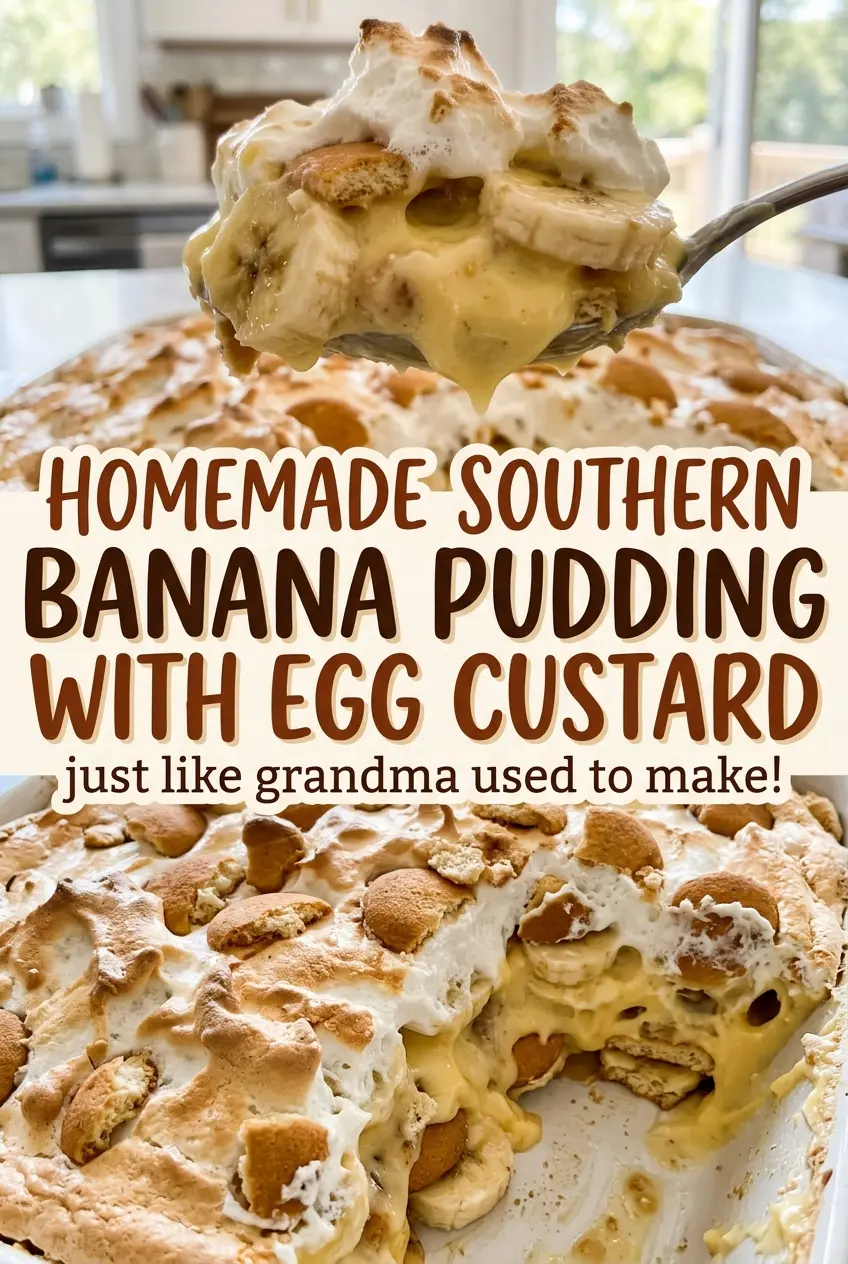
I layer the wafers, ripe bananas, and custard in thirds so every scoop gets a little of each. The wafers soften as they sit against the warm custard, while the banana slices stay distinct rather than disappearing into it. A cloud of meringue goes over the top and turns golden in the oven, giving the pudding its classic finish. The first spoonful has soft wafers, smooth custard, and tender banana in the same bite.
Kitchen Note
Give the baked pudding the full 20-minute rest before serving. The custard settles during that time, so the layers are easier to scoop neatly instead of sliding apart.
Save this homemade Southern banana pudding for its silky egg custard, soft vanilla wafers, ripe banana layers, and golden meringue top.
Why the Custard Has to Thicken Before It Meets the Wafers
Banana pudding gets its layers from more than the cookies. The custard has to be thick enough to sit between them, because the wafers absorb moisture as the pudding rests. If the custard goes into the dish while it’s still thin, it can run down to the bottom before it has a chance to coat the layers evenly.
Flour gives this custard its body, but it needs to be cooked in the milk mixture before the yolks go in. Then the yolks are tempered with some of that hot mixture and returned to the pan. That gradual warming helps the yolks blend into the custard smoothly instead of turning into little bits of cooked egg. It’s a simple bit of pacing that makes the finished pudding feel creamy rather than pasty or loose.
Once the custard is ready, the thirds matter, too. Repeating the layers means you don’t end up with all the banana in one section and plain wafers in another. The goal is a balanced spoonful all the way through the dish, with custard reaching the cookies rather than sitting only on top.
The Ingredients That Keep the Custard Rich and the Layers Intact

- Whole milk gives the custard a fuller texture than low-fat milk. A standard grocery-store brand works well; the main thing is using whole milk for the richness this pudding is built around.
- All-purpose flour thickens the custard and helps it hold between the cookie and banana layers. Whisk it thoroughly with the sugar and salt before adding the milk so it disperses evenly.
- Eggs do two jobs here: the yolks enrich the custard, and the separated whites become the meringue. Separate carefully so yolk doesn’t get into the whites, which can interfere with whipping.
- Vanilla wafers are thin and crisp enough to soften under the warm custard without turning the layers into a dense cake. A store-brand package is fine; you don’t need specialty cookies.
- Ripe bananas bring sweetness and a soft but recognizable slice through the pudding. Choose fruit that’s ripe but still holds its shape when sliced, rather than bananas that are collapsing or heavily bruised.
- Granulated sugar is divided between the custard and meringue. Keeping the portions separate matters: the custard needs its share in the saucepan, while the remaining sugar is beaten into the whites.
- Butter, vanilla extract, and cream of tartar each have a small, specific job. Butter and vanilla finish the warm custard, while cream of tartar helps the egg whites form a stable meringue; ordinary grocery-store versions are suitable.
From Flour-Thickened Base to Golden Meringue
Cook the milk and flour base until it thickens
Heat the oven to 350°F and grease a 2-quart baking dish. In a medium saucepan, whisk together the custard portion of the sugar, flour, and salt, then gradually whisk in the milk until smooth. Cook over medium heat, whisking constantly for 6–8 minutes, until the mixture thickens and just begins to bubble. Keep the whisk moving across the bottom of the pan so the flour mixture doesn’t catch there.
Temper the yolks and finish the custard
Whisk the yolks in a heatproof bowl. Slowly whisk about 1 cup of the hot milk mixture into the yolks, then whisk that mixture back into the saucepan. Cook over medium-low heat, whisking constantly, until the custard returns to a gentle boil and reaches 160°F; let it boil for 1 minute. Take the pan off the heat and stir in the butter and vanilla until the butter melts.
Build the banana and wafer layers
Arrange about one-third of the vanilla wafers in the prepared dish, then add half of the banana slices and one-third of the custard. Repeat with another third of the wafers, the remaining bananas, and another third of the custard. Finish with the last wafers and custard. Keep the layers fairly even so each serving gets cookies and banana from more than one level.
Whip and bake the meringue
In a clean, dry bowl, beat the reserved egg whites with the cream of tartar at medium speed for 1–2 minutes, until soft peaks form. Gradually beat in the remaining sugar, then increase to medium-high and beat for 2–3 minutes, until the meringue is stiff and glossy. Spread it over the pudding and seal it to the edges of the dish. Bake for 15–20 minutes, until the top is golden and the center of the meringue registers 160°F.
Two Ways to Change the Finish Without Losing the Custard
Make a gluten-free version
Use a cup-for-cup gluten-free flour blend in place of the all-purpose flour, and choose vanilla wafers labeled gluten-free. The custard may thicken at a slightly different pace depending on the blend, so follow the same visual cue: it should be thickened and just beginning to bubble before you temper in the yolks.
Leave off the meringue for a chilled pudding
For a simpler, cooler finish, layer the custard, bananas, and wafers without making the meringue, then refrigerate the assembled pudding and serve it cold. You’ll trade the toasted, pillowy topping for a softer, more custard-forward dessert.
Storage and Reheating
- Refrigerator: Refrigerate leftovers within 2 hours and keep them covered. They’re best within 3–4 days; the wafers will continue to soften and the meringue may lose some of its lift.
- Freezer: Freezing isn’t a good fit. The custard can turn grainy as it thaws, and the bananas and meringue won’t keep their original texture.
- Reheating: I serve leftovers chilled rather than reheating them. Heat can loosen the custard and flatten the meringue, so skip the microwave for this one.
Questions That Come Up While the Pudding Is in the Oven
Homemade Southern Banana Pudding with Egg Custard
Ingredients
Equipment
Method
- Preheat the oven to 350°F and grease a 2-quart baking dish.
- Whisk 3/4 cup of the divided sugar with the flour and salt in a medium saucepan, then gradually whisk in the milk until smooth.
- Cook over medium heat, whisking constantly, for 6–8 minutes, until the mixture thickens and just begins to bubble.
- Whisk the egg yolks in a heatproof bowl, slowly whisk in about 1 cup of the hot milk mixture, then whisk the yolk mixture back into the saucepan.
- Cook over medium-low heat, whisking constantly, until the custard returns to a gentle boil and reaches 160°F, then boil for 1 minute.
- Remove the saucepan from the heat and stir in the butter and vanilla until the butter melts.
- Arrange about one-third of the wafers in the prepared dish, top with half the banana slices and one-third of the custard, then repeat with another third of the wafers, the remaining bananas and another third of the custard; finish with the remaining wafers and custard.
- In a clean, dry bowl, beat the reserved egg whites with the cream of tartar at medium speed for 1–2 minutes, until soft peaks form.
- Gradually beat in the remaining 1/3 cup sugar, then beat at medium-high speed for 2–3 minutes, until the meringue forms stiff, glossy peaks.
- Spread the meringue over the pudding, sealing it to the edges of the dish, and bake for 15–20 minutes, until golden and the center of the meringue registers 160°F.
- Rest for 20 minutes before serving, and refrigerate leftovers within 2 hours.
